The Futility of Ledgers
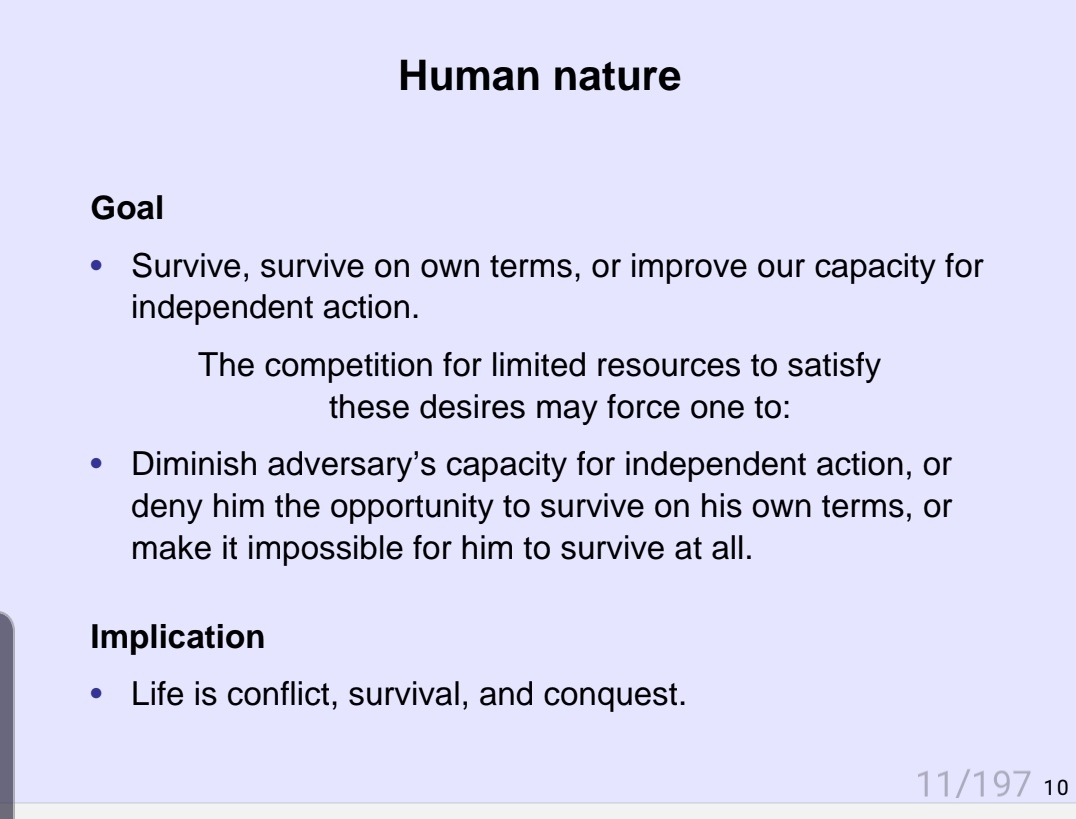 Patterns of Conflict by John Boyd
IF YOU HAVEN’T NOTICED…
- Survival Drives Precede Morality
* Before ethics, before language, came the biological imperative: secure resources, eliminate threats, reproduce advantage. Nation-states are merely scaled-up organisms in geopolitical ecosystems.
* Their actions—war, colonization, exploitation—are not deviations from morality; they are **expressions of evolutionary logic** , optimized over millennia for group survival.
2. Ledgers Don’t Deter Power—they Serve It
* The concept of justice often conceals power politics. Calling out sins selectively is just another form of warfare by other means.
3. Everyone Is Dirty, So Moral High Ground Is Illusory
* No civilization rises clean. Genocide, displacement, and deception are universal tactics in the birth of states.

* To point fingers is to ignore the systemic nature of the game: **"might makes right" is not a flaw—it’s the rulebook.**
4. Cataloguing Guilt Doesn’t Change Behavior
* Nations do not change course because of shame; they change because of **force, leverage, or cost-benefit shifts.**

* Moral memory rarely prevents atrocities—it merely **archives them for retrospective outrage.**
5. The Red Queen’s Race Is the Core Dynamic
* Organisms must continuously evolve not to get ahead but to merely survive.

* In an ever-accelerating arms race, standing still is death. Empires rise and fall not based on virtue but on adaptability and aggression.

* The ledger doesn't stop the race—it **distracts from it**. While we tally sins, others optimize for survival.
🔥 Core Thesis:
“In a system governed by evolutionary competition and perpetual struggle, moral ledgers are little more than post-hoc rationalizations. Real power lies not in remembering history, but in surviving it.”

America proves that it doesn’t matter who has claim over the land. Turns out, if you can’t defend it…it’s not yours.
If might is right, then keeping track of who did what is a moot point, no?
If might is right than keeping track of who did what is a moot point, no?
Why keep a ledger of sins when everyone’s hands are just as bloody as the next? I’m just wondering why cataloguing nation-state sins is useful when everyone is just as guilty in history’s ledger. I’d like a clear answer to this: I’m just wondering why cataloguing nation-state sins is useful when everyone is just as guilty in history’s ledger.